
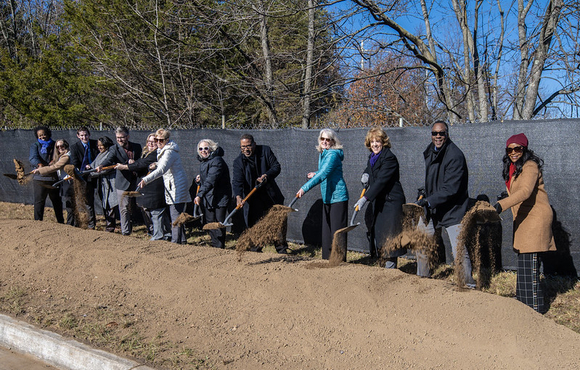
ELLICOTT CITY, MD – Howard County Executive Calvin Ball today broke ground on the County’s new Non-Congregate Shelter, the first of its kind in Howard County. In June 2025, the County purchased land at 9530 Lynn Buff Court to construct the County’s first-ever Non-Congregate Shelter along the Route One Corridor in North Laurel.
This new 16,000 square foot, 22-room facility will expand the county’s shelter capacity by providing short-term private shelter, comprehensive assessments, and immediate referrals to housing and critical services. Photos from the event can be found on Howard County Government’s Flickr webpage and video on the County Executive’s Facebook page.
For too long, individuals and families who needed short-term stabilization and private space to regain their footing simply didn’t have sufficient options – our first non-congregate shelter is changing that. When we purchased this land along the Route One Corridor in June, we did so with a clear purpose: to reimagine what emergency shelter can look like, and to fill a longstanding gap in our crisis-response system. As a key aspect of our The Path Toward Zero: Howard County’s Strategic Plan to End Homelessness 2025–2030 plan, this facility is an investment, a promise, and a step forward in our shared effort to make homelessness rare, brief, and non-recurring in Howard County. Together, with our partners, we are building the strongest homelessness response system in Howard County’s history and a place where every family has the opportunity to thrive.
Unlike traditional emergency shelter which provides shared rooms for multiple families, non-congregate shelter provides private bedrooms with private bathroom facilities for each household. These private rooms are especially important for families, people with disabilities, older adults, and those with illnesses who would benefit from additional privacy in the homeless system. This County building will also include a commercial kitchen within the building to allow for shared meals for those accessing housing services. Focused on rapid housing stabilization, the County’s Department of Housing and Community Development (DHCD) plans to offer benefits and onsite services at the new Non-Congregate Shelter, including:
- Immediate assessment of client needs;
- Completion of homelessness verification;
- Complete housing assessments;
- Immediate connection to Coordinated Entry System and referral for housing resources;
- Appropriate referrals for critical needs, including mental and behavioral health supports;
- Assistance with rapid return to housing using brief case management and diversion strategies that strive for immediate solutions that:
- Help individuals and families avoid entering shelters, reducing strain on emergency shelter and allowing emergency shelter resources to focus on those with more complex needs and
- Help identify alternative/non-shelter-based solutions, such as family reunification, re-establishing a lease, and/or restoring shared living arrangements
- Serve as an exit destination for individuals who time-out of 23-hour crisis beds at Grassroots Crisis Intervention
- Serve as overflow beds for Grassroots’ emergency shelter at Freetown Road in Columbia
- Serves as a warming center for Code Blue and Cold Weather Shelter
- Backup space to Grassroots Day Resource Center at Leola Dorsey, as well as transportation and connection services at the center `
- Commercial kitchen for facility will serve as backup kitchen for Grassroots
State and local leaders have a responsibility to ensure no one lives outside and that our unhoused neighbors have dignified, safe places to lay their head at night. The groundbreaking of Howard County's non-congregate shelter represents a new framework for addressing homelessness in this community. Howard County is laying the groundwork for success by making shelter housing-focused from day 1 by offering comprehensive support services and housing navigation. Congratulations to County Executive Ball and the entire Howard County DHCD team on this incredible achievement.
In his Fiscal Year (FY) 2026 Capital Budget, Ball included $9.15 million – $5.07 million in County funding and $4.077 million in American Rescue Plan Act funding, to advance this project forward. Ball plans to include an additional $1.5 million in his FY 2027 Capital budget to complete the project, bringing the County’s total investment in the project to $10.65 million. Construction on the project is scheduled to begin this month and is expected to be completed by summer 2027.
Here's what others had to say about the County’s new Non-Congregate Shelter:
- Kelly Cimino, Director of the Howard County Department of Housing and Community Development – “The new non-congregate shelter at Lynn Buff will add significant capacity to our homeless response system in 2027,” said Kelly Cimino, DHCD Director. “As we begin implementation of our new five-year The Path Toward Zero plan, we appreciate the County’s investment and recognition of the need for this project to serve vulnerable residents in our community.”
- Matthew Castner, Member of the Howard County Coalition to End Homelessness Board – “The Coalition to End Homelessness is a group of passionate, clever troublemakers who will not stop as long as people in our community are homeless or at-risk of becoming homelessness. As someone who lives and works in Howard County, I support the County’s 5-year Plan to End Homelessness and the construction of the Non-Congregate Shelter at Lynn Buff.”
- Cedric Brown, Chair, Housing and Community Development Board – “I commend County Executive Ball and the Department of Housing and Community Development for having the foresight and courage to fund a non-congregate shelter. Having four walls and a door to close when you sleep at night will provide healing spaces and emotional stability for people experiencing housing instability.”
- Jackie Eng, Coordinator, Housing Affordability Coalition – “Thank you to the Department of Housing and Community Development and everyone who has worked on addressing homelessness – for being open, seeing creative approaches, and finding solutions. I am so proud to be a part of this community that can make these things happen. Our heartfelt thanks to County Executive Ball, Director Cimino, the County Council, and everyone involved in bringing this project forward. This incredible project is something that we should aspire to moving forward.”
Building on the County’s Plan to End Homelessness
The Non-Congregate Shelter builds on the County’s updated five-year plan to end homelessness, which Ball unveiled this past month. Developed in partnership between DHCD and Coalition to End Homelessness, The Path Toward Zero outlines the major goals and interventions to achieve “functional zero” over the next five years, and to ensure a comprehensive system of homeless services to resolve homelessness in Howard County. Functional zero is achieved when the number of people experiencing homelessness is consistently below the community's capacity to house them so that homelessness becomes a rare, short-term crisis with rapid return to stable housing.
The Path Toward Zero is a strategic document to ensure the work of the County and its non-profit partners meets the needs of the community. In addition to furthering critical projects, like the Non-Congregate Shelter, the key goals of The Path Toward Zero include:
- Restructuring the coordinated entry and assessment processes to increase access to appropriate services;
- Expanding prevention and diversion strategies to reduce the number of people experiencing homelessness; and
- Scaling effective housing interventions that lead to permanent housing solutions.
Furthermore, the Non-Congregate Shelter also builds upon Grassroots’ two-part renovation project to take its emergency shelter capacity from 51 to 90 beds. In December 2024, Ball joined Grassroots to cut the ribbon on the completion of the project’s first phase, which created 20 new beds, five new shower areas, and a fully-equipped laundry room. Grassroots recently celebrated the completion of the project’s final phase, that added another 19 beds and an additional ADA-compliant bathroom with a shower to the shelter. The first significant expansion of bed capacity at the facility since 2008, this project increased the shelter’s total bed capacity by more than 75 percent. To help make the two-phase renovation and expansion project possible, Ball provided approximately $1 million in federal American Rescue Plan Act funds.
Grassroots has been serving Howard County since 1970, when it opened its first informal shelter. Since then, it’s been providing free 24-hour crisis intervention, mental health, substance use disorder, housing support, and suicide prevention services to community members. In FY 2025 alone, Grassroots provided emergency shelter to 238 clients for a total of 25,106 shelter bed nights. It supported an additional 39 individuals through the Cold Weather Shelter program and 258 individuals through the Code Blue shelter, which provides refuge for people when the temperature reaches 26 degrees or below.
In addition to Grassroots, Bridges to Housing Stability’s Family Home Start Program provides housing assistance to families that are experiencing homelessness and have children in Howard County Public School System’s (HCPSS) schools. Launched in 2024 as part of Ball’s Housing Opportunities are Meant for Everyone (HOME) initiative, Bridges has rehoused 76 households comprised of 279 individuals (including 140 HCPSS students) with this assistance as of September 30, 2025.
Finally, in March 2024, Ball launched a new pilot Student Rental Subsidy Program designed to help Howard Community College (HCC) students find and rent apartments in Howard County. Created in partnership between DCHD, HCC, and the Columbia Housing Center (CHC), the program provides recipients with monthly rental stipends for two years as they complete their degrees at HCC. Administered by CHC, the program aims to help alleviate the financial constraints that students face in securing suitable accommodations during their educational journey. As of September 30, 2025, 50 students and their families have received assistance through the program.