
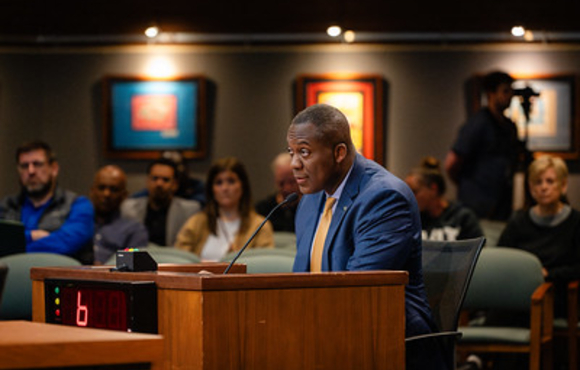
ELLICOTT CITY, MD – Howard County Executive Calvin Ball today unveiled his $2.5 billion Fiscal Year 2027 (FY27) Operating Budget to the Howard County Council. The proposal is comprised of a balanced spending plan that prioritizes Howard County’s shared values and core needs, while navigating emerging fiscal challenges. The General Fund budget totals $1.7 billion, a 6.8 percent increase from Fiscal Year 2026 (FY26) Operating Budget, due primarily to an increase in certain revenues, such as capital gains. Ball’s proposed FY27 Operating Budget maintains support for core services and makes strategic investments without increasing property or income taxes for residents. Photos of Ball’s presentation to the County Council can be viewed County’s Flickr website, and the PowerPoint presentation is on the Howard County Government’s website.
Our budget is a reflection of our priorities, values, and commitment to the residents and businesses of Howard County. Our FY27 spending plan, my last as your Howard County Executive, ensures that we are providing significant resources to support public education and lifelong learning for residents of all ages. At the same time, we recognize the affordability crisis that is burdening many of our families and businesses. Our budget balances these community priorities without increasing property and income taxes on our residents and businesses. Together, we continue to exercise strong fiscal planning, budget responsibly, and innovatively deliver services for our county. As this budget is reviewed, I would like to thank our residents, businesses, community organizations, and the Howard County Council for the input shared throughout the budget process. I am especially grateful to our hard-working employees for maintaining essential services and addressing the needs of our residents while ensuring Howard County remains the best place to live, work, play, grow, and thrive for all.
Providing the Best Education System for All
Ball’s proposed FY27 budget includes direct, recurring County funding of $871.5 million to the Howard County Public School System (HCPSS), contributing to a total HCPSS budget of $1.28 billion when combined with other funding sources. This includes an unprecedented seven percent, or $57 million, increase in recurring County funding to HCPSS – the highest annual growth in the County’s history, exceeding the State-mandated Maintenance of Effort (MOE) funding by $60.8 million. This funding increase builds upon substantial funding commitments made by Ball during his time in office. Since FY19, recurring County funding support for HCPSS has grown by nearly 50 percent.
Ball’s operating budget funds 99.3 percent of the Board of Education’s (BOE) funding request in FY27, demonstrating the County’s strong commitment to stretch resources to support the BOE’s priorities. Through collaboration and partnership with the Superintendent and BOE, HCPSS will fully meet any remaining FY27 budget needs through use of fund balance and other internal savings strategies.
“Today is a great day for the students, educators, and families of the Howard County Public School System,” said Bill Barnes, Superintendent of Howard County schools. “This significant investment in education by County Executive Calvin Ball provides a clear path forward, allowing me to recommend a solution to the Board of Education that leverages updated projections and available unassigned fund balance to achieve a balanced budget while honoring each of the Board’s priorities and our shared strategic investments. I extend my sincere appreciation for County Executive Ball's continued commitment to public education and look forward to working with our Board of Education and County Council to conclude this budget season on a high note.”
This proposed budget directs nearly two thirds of total revenue growth in the County General Fund to direct spending on HCPSS services, which comprises $77 million in new resources or 66.1 percent of total new funding. This allocation of new revenue includes use of $14.5 million to replenish one-time funding included in Ball’s FY26 Operating Budget for on-going expenditures in HCPSS’s base (Council Bill 45-2025), as well as new costs shifted to the County budget from the State for HCPSS educators’ pension liabilities ($2.6 million increase in FY27; $9.3 million total) and funding for private pre-K local match ($2.9 million).
“On behalf of the Board of Education, thank you to County Executive Ball for committing to fund 99.3 percent of the Board’s Operating Budget request,” said Jennifer Swickard Mallo, Board of Education Chair. “It is an investment in Howard County’s students, educators, and families. This support truly matters, and we do not take it for granted. While work remains in the budget process to finalize the details, this funding allocation provides stability by protecting essential programs, strengthening support for Multilingual Learners and students who receive special education services, expanding Prekindergarten, and investing in our educators and staff to whom we want to pay fair and meaningful wages. We have been given a clear path forward.”
In addition to direct County funding to support HCPSS needs, an additional $58.6 million is proposed in the County’s Non-Departmental budget to support other HCPSS related expenses, including:
- $50.1 million in debt service payments for school infrastructure projects;
- $7.5 million for Other Post Employment Benefit (OPEB) contributions to meet retiree health benefits of school employees; and
- $0.7 million one-time PAYGO for school employees OPEB long-term liabilities.
- An additional $300,000 continues the successful educator Loan Repayment program, assisting HCPSS educators in the repayment of their student loans.
Since taking office in December 2018, Ball’s administration has increased the County’s operating support to HCPSS by more than $280 million. These funding increases have supported HCPSS at a time when enrollment has declined and remained stagnant since the COVID-19 pandemic. In FY27, K-12 enrollment is expected to decrease, while pre-K is anticipated to see modest growth. This support has allowed for the significant implementation of the Blueprint for Maryland’s Future, including raising starting teacher salaries, expanding pre-K, bolstering support for career and technical education, and dramatically increasing funding for special education.
Moreover, Ball’s proposed FY27 Operating Budget features additional support to school-aged children outside of the classroom, including:
- $500,000 in one-time funds on top of $750,000 in the base to enhance the HoCo STRIVES (Strategies To Reach an Inclusive Vision and Equitable Solutions) program, supporting youth mental health, transportation access to programs, and a new summer teaching initiative;
- $600,000 to continue the Youth Engagement Programming (YEP!) initiative, offering free and low-cost youth programming; and
- $245,000 in one-time investment to expand school-based wellness centers.
Furthermore, the proposed budget provides a $1.4 million funding increase to Howard Community College (HCC), fully funding HCC’s request to support operational, curricular, and co-curricular needs. Our 3 percent funding increase to HCC ensures the college continues to provide a quality education to learners of all ages in Howard County.
Moreover, the proposed budget provides a $1.7 million funding increase to the Howard County Library System (HCLS) in FY27, reflecting a 6.2 percent increase in recurring funding for HCLS. This significant funding increase will fully cover the collective bargaining agreement between HCLS and Howard County Library Workers United, part of AFSCME Maryland Library Workers United (Local 6359), protect all library jobs, including on-call library shelver positions, and support other cost drivers within HCLS, including materials and library offerings that promote lifelong learning.
Bolstering Public Safety
In continuing to boost public safety by equipping the County’s first responders with essential support as they serve and protect the community, Ball’s proposed FY27 Operating Budget includes a $9.3 million increase for the Howard County Police Department (HCPD). This historic funding for HCPD builds upon Ball’s prior efforts to add 24 new patrol positions to HCPD, which was the largest increase in sworn personnel in 15 years. Since taking office, Ball has increased funding for HCPD by nearly 45 percent, reflecting an increase of more than $50 million. This critical funding ensures that HCPD remains fully staffed and equipped to support public safety needs. This FY27 increase supports ongoing staffing needs and services that will increase community engagement and systemic enhancements and includes:
- $400,000 to implement a new County-wide security camera management system;
- $245,000 for the installation of two additional speed cameras near schools to enhance safety enforcement; and
- One-time funds of $540,000 for equipment replacements and signing bonuses to help recruit top candidates.
The proposed budget also includes $168.9 million from the Fire Fund for the Department of Fire and Rescue Services (DFRS), reflecting an increase of $5.6 million that supports staffing and equipment to ensure effective emergency response. Following significant efforts to bolster resources and fill multiple recruit classes, Ball announced in 2025 that DFRS is fully staffed. This funding will also help expand DFRS’s Mobile Integrated Community Healthcare to bolster support for older adults and communities with high demand on emergency services. DFRS’ budget also includes a $2.6 million one-time transfer to capital projects, with $500,000 allocated for rural cisterns and $2 million to begin construction of Fire Station 15.
Furthermore, the proposed budget includes:
- Half-year funding for a new position in the Office of the State’s Attorney for Howard County’s Juvenile Crimes section, as well as $20,000 to reclassify four Victim Witness Advocate positions appropriately;
- $271,000 in partial year funding to create four new deputy sheriff positions within the Howard County Sheriff's Office to improve courthouse safety, plus $378,000 in one-time funds for vehicles for the new positions;
- Half-year funding for both a new court reporter and juvenile case manager within the State’s Circuit Court for Howard County; and
- Funding for four new correctional officer positions within the Department of Corrections, aimed at improving the safety of both staff and incarcerated individuals at the Howard County Detention Center and reduce overtime spending.
Investing in Community Health
With investments in emergency room capacity, mental health treatment, addiction recovery, and maternal health, Ball’s proposed FY27 Operating Budget continues to prioritize community health to ensure all residents of all ages can work, live, play, grow, and thrive. This includes:
- $5 million in one-time funds to support the construction of Johns Hopkins Howard County Medical Center’s Medical Observation Unit expansion with the emergency department. This funding fulfills Ball’s $15 million commitment to help create a 29-bed observation unit to reduce wait times and improve care.
- $200,000 to bolster support for Grassroots Crisis Intervention’s 24/7 Mobile Crisis Team for mental health and psychiatric emergencies and to enhance coordination across agencies.
- Approximately $3.1 million of Opioid Restitution Funds will add two additional peer recovery specialists, support Sheppard Pratt’s residential treatment center, and expand programming at Tuerk House’s Highland House, Howard County’s only halfway house for pregnant women.
- $691,000 of one-time funds to boost Howard County Health Department’s maternal and infant health program, support its community health worker pilot program, and expand its school-based wellness programs.
- $275,000 for a menstrual equality program in all County-owned public facing buildings.
- $200,000 to expand the County’s Department of Recreation & Parks’ Automated External Defibrillator program.
Growing Homeownership, Advancing Affordability, and Meeting Community Needs
Ball’s proposed operating budget allocates more than $10 million to homeownership initiatives, housing rehabilitation, affordable housing, and homelessness prevention programs administered by the County’s Department of Housing and Community Development (DHCD). This includes:
- $2.1 million for homeownership programs;
- $2 million for the acquisition or preservation of affordable housing units under the Right of First Refusal program;
- $1 million for the creation and preservation of units in a new, mixed-income rental community;
- $1 million for home rehabilitation programs for low-income households;
- $1 million to provide rental assistance to HCPSS and HCC student households experiencing housing instability and housing cost burden; and
- $1.5 million to support homeless services.
The budget also allocates $1 million in one-time funding to support DHCD’s Housing Opportunities Trust Fund, which was created in 2022 to promote access to affordable housing through innovative housing programs and construction of new affordable housing communities.
Additionally, $2 million in funding from DHCD’s Community Renewal Fund with be transferred to the FY27 Capital Budget for the construction of the County’s first-ever Non-Congregate Shelter along the Route One Corridor in North Laurel. A key goal of the County’s new five-year plan to end homelessness, The Path Toward Zero: Howard County’s Strategic Plan to End Homelessness 2025–2030, this 22-room facility will expand shelter capacity in Howard County by providing short-term private shelter, comprehensive assessments, and immediate referrals to housing and critical services.
The proposed budget also includes $165,000 from Ball’s new LIVE (Landlord accountability, Investment in quality, Victim protection and Eviction prevention) initiative to reinstate partial-year funding for an electrical position and add a rental housing inspector position within the County’s Department of Inspections, Licenses, and Permits. This also include funding for the Office of Consumer Protection to support landlord-tenant affairs and expand arbitration.
The FY27 operating budget includes $15.2 million Community Service Partnership (CSP) grants to support non-profits, reflecting a 6.7 percent increase from the prior year. Since taking office, Ball has increased funding to local nonprofit service providers by more than 35 percent, reflecting an increase of nearly $4 million. This investment expands critical support for nonprofits that provide housing security, educational services, food assistance, mental health services, and more. Additionally, $83,000 in PAYGO funding is also included to support the one-time needs of CSP grant recipients.
Fostering a Stronger Economy
Given the stark federal and state impacts the County continues to absorb, Ball’s proposed FY27 Operating Budget continues to prioritize programs and initiatives that support entrepreneurs, build the talent pipeline, grow the local economy, and increase global competitiveness by allocates $1.1 million in one-time funds to the Howard County Economic Development Authority (HCEDA). This funding will help HCEDA support various business and expansion programs, including:
- $300,000 for Gateway Innovation Fund to provide matching capital to private investment;
- $250,000 for the Activation for Community Transformation Loan Fund to reduce commercial vacancies and strengthen the vitality of Howard County village and strip centers;
- $250,000 for the Main Street Revitalization Program to provide small capital improvement grants to main street businesses in Elkridge and Ellicott City;
- $200,000 incentives for current restaurant park properties to install improvements;
- $100,000 for scholarships for Howard County startups to participate in specialized bootcamps and cohorts; and
- $20,000 in grants for local businesses to improve their export capabilities.
The budget also supports a new position at the Maryland Innovation Center, a premier business incubator and accelerator operated by HCEDA, and a part-time underwriter position to help manage HCEDA business loans.
In addition, Ball’s proposed budget includes funding for an apprenticeship coordinator position previously funded through American Rescue Plan Act funds and a new position in the Office of Workforce Development (OWD) to support its career counseling and other workforce services. The budget also features $250,000 in one-time funds for emerging workforce development initiatives not covered by grant programs, including continued workforce support for impacted federal workers.
Furthermore, the proposed budget includes $350,000 to expand OWD’s Summer Youth Employment Program to 360 students, providing workforce opportunities for students, with an emphasis on students who are economically disadvantaged or navigating a significant barrier.
Advancing Environmental Initiatives and Supporting Public Facilities
Ball’s efforts to increase Howard County’s energy independence, strengthen climate resilience, and promote agriculture have been a hallmark of his more than seven years as Howard County Executive. To continue supporting these long-term sustainability measures, his proposed budget establishes the Clean Energy and Community Sustainability Fund. This fund will allow for the lasting operations and maintenance of County-owned solar projects, as well as the initiation, promotion, and management of other renewable energy, climate mitigation, and resiliency efforts on County properties and within the greater community.
The proposed budget also includes half-year funding for a new position to support the Office of Community Sustainability’s CleanScapes Program and another position in Department of Public Works (DPW) to help with watershed restoration and rehabilitation efforts.
Additionally, the proposed budget allocates:
- $240,000 in PAYGO funds to support one-time costs for various sustainability and energy independence initiatives consistent with the County’s HOWARD COUNTY CLIMATE FORWARD: Climate Action and Resiliency Plan, including replacing gas-powered landscaping equipment;
- $100,000 in one-time funding to fund EcoWorks’ capital costs on top of $500,000 on-going funding to support its various environmental services and workforce development programs;
- $60,000 in one-time funds to support Power52’s workforce development pilot program focused on updating workforce training with new technological advancements in renewable energy;
- $520,000 in one-time funding to support tree planting and giveaways, and other environmental preservation projects; and
- $350,000 to support the County’s Department of Recreation & Parks’ hazardous tree removal.
The proposed budget also increases support for Howard County’s agricultural sector with an additional $100,000 investment in the Agricultural Innovation and Expansion Grants program, bringing the total investment to $200,000 in FY27. Our budget includes sustained funding of:
- $122,000 for marketing grants;
- $500,000 for enhanced agricultural grants;
- The consolidation of several contingent positions within the Office of Agriculture (OoA) to fund a new position supporting OoA’s Roving Radish food program; and
- Introduces OoA’s new countywide education initiative, The Farmer’s Circle, to strengthen farm visibility and awareness.
Additionally, the proposed budget also continues to support the Department of Recreation & Parks’ community facilities and services with $270,000 allocated to support the opening of Ilchester Park and $360,000 to replace ARPA funding for childcare and camp scholarships, as well as childcare staff stipends.
Growing an Inclusive and Accessible Transportation Network
Ball’s proposed FY operating budget also prioritizes transportation needs and infrastructure by reinstating partial year funding for a road maintenance crew position in DPW and continues critical funding for road treatment and snow removal during major weather events. Additionally, the budget funds key transportation projects to keep Howard County connected and well-maintained, including:
- More than $12 million in one-time funds to support transportation-related capital projects, including $10.2 million for road resurfacing and $2 million for sidewalk and multimodal projects;
- $157,000 to extend the existing RTA Route 409-bus service along the Route One Corridor from Elkridge to Lansdowne in Baltimore County, providing a more direct connection to MTA MARC service at Halethorpe; and
- A $200,000 one-time grant to the Columbia Association to provide improvements to an existing pathway from Harpers Farm Road to Swansfield Waterpark, saving an estimated $1 million in County funds in the capital budget.
Ensuring Effective Government
Ball’s proposed FY27 Operating Budget furthers his administration’s reorganization efforts to strengthen County service delivery and efficiency. In FY27, this includes transferring the Office of Central Services (including mail and fleet services) to the Department of General Services to streamline operations.
The budget also supports County employees by addressing critical needs, including:
- $5 million in PAYGO to provide one-time assistance to the Health Benefit Fund to mitigate its growing deficit, which is primarily driven by escalated claim costs;
- $3 million toward a voluntary separation incentive program to provide generate future budget savings;
- $1 million as a one-time contribution to the OPEB (Other Post Employment Benefits) Trust Fund to address long-term liabilities for HCPSS and HCC retirees; and
- New positions for an IT audit manager position in the County Council and a litigator in the County’s Office of Law.
The budget also includes $510,000 in one-time State mandated funds for the purchase of election pollbooks and ballot devices, covering the first of a three-year commitment that is expected to exceed $2 million.
Uncertain Fiscal Outlook and Emerging Challenges
The FY27 Operating Budget was prepared amid continued uncertainty, due to ongoing workforce and funding challenges at the federal level and global conflicts impacting prices. Under the current federal administration, the Department of Government Efficiency (DOGE) took swift action to decimate the federal workforce, with significant impacts on Maryland families.
Statewide, 15.3 percent of Marylanders reportedly lost jobs through November 2025. With 11 percent of Howard County residents directly working for federal agencies and many more working for federal contractors or non-profits that receive federal funding, the potential impact of federal actions remains a concern. Due to the lagging nature of the income tax filing and reconciliation process with the State, these federal impacts are expected to materialize over a longer period of time and may not be fully captured.
Additionally, Howard County continues to absorb increased costs shifted from the State of Maryland, which are billed directly to Howard County Government. In FY27, these cost shifts amount to $7.4 million in new expenses that must be covered directly by Howard County. This $7.4 million increase builds upon nearly $9.3 million in State costs shifted to Howard County during the FY26 budget process for HCPSS/HCC pensions and operations of the Maryland State Department of Assessments and Taxation. Collectively across FY26 and FY27, Howard County will have absorbed more than $16.7 million in new costs from the State in the local budget in just these two fiscal years.
Finally, Ball included $1.5 million in one-time funds in his proposed FY27 Operating Budget to ensure the County can respond to unanticipated federal impacts and emerging needs that may arise in the year ahead, due to ongoing workforce and funding challenges at the federal level and global conflicts impacting prices.
Despite strong revenue performances thanks to capital gains and solid property taxes collections, Howard County’s overall labor market remains a key area of concern and focus. With 11 percent of Howard County residents directly working for federal agencies and many more working for federal contractors or non-profits that receive federal funding, the potential impact of federal actions remains a concern. Moreover, although median household income has risen in recent years, total employment remains below the pre-pandemic level.
Even with these difficulties, Howard County’s strong financial management once again earned it a AAA credit rating from all three major rating agencies, a financial accomplishment achieved for each of the last eight years. This AAA rating ranks the County among the top two percent of jurisdictions nationwide with this distinction.
For more information and to view the full FY27 Operating Budget proposal, visit www.howardcountymd.gov/budget-office/budget-publications.