
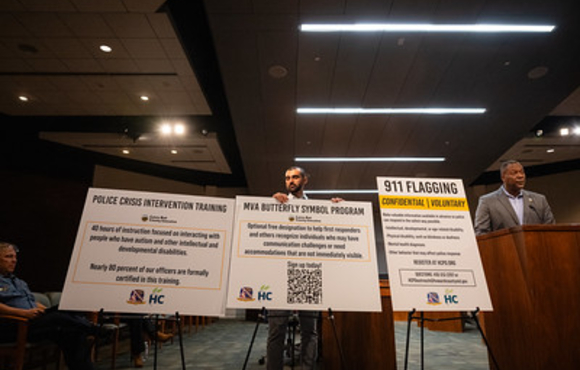
ELLICOTT CITY, MD – Howard County Executive Calvin Ball today was joined by Police Chief Gregory Der to announce impactful solutions, resources, and support Howard County Government is launching to help build an even more responsive and compassionate system following the recent Howard County Police Department (HCPD) officer involved shooting on Sunday, March 1st in the 6400 block of Freetown Road in Columbia. View photos of the announcement on the County’s Flickr page.
During the past five years, HCPD has handled more than 5,000 emergency-petition calls involving people threatening to harm themselves or others. While the outcomes of these incidents have been consistently safe – with the person in crisis being transported to a hospital for evaluation, that is unfortunately not always the case. While no words can adequately express the sorrow felt following the tragic police-involved shooting that resulted in the death of a member of the autism community, Alex LaMorie, as leaders, we must acknowledge that pain, listen carefully, and respond with both humility and resolve. We remain committed to working closely with law enforcement, disability advocates, mental health professionals, and members of the autism community to identify meaningful improvements to reassure all that interactions with our public safety personnel will be safe and compassionate.
Currently, HCPD offers a 911 Flagging Program that allows individuals, family members, and/or caregivers to voluntarily register a person with a developmental, intellectual, degenerative, or physical disorder or disability with the County’s 911 Center. This program allows first responders to be alerted when responding to a call that a person involved has a certain condition, providing responding personnel with valuable information and ways to help before they even arrive. All information maintained in HCPD’s 911 Flagging Program remains confidential.
To further strengthen HCPD’s 911 Flagging program, Ball announced the department will be working with the County’s Department of Housing and Community Development to explore flagging buildings and communities in the county that provide housing for adults with disabilities.
HCPD officers and dispatchers also receive specialized Crisis Intervention Training, which includes 40 hours of instruction on how to more effectively and safely interact with individuals who have autism and other intellectual and developmental disabilities, including mental health issues. This training is conducted in partnership with the National Alliance on Mental Illness and Grassroots Crisis Intervention Center. It provides officers with an advanced level of mental health awareness, de-escalation techniques, active listening skills, and trauma-informed policing practices. Nearly 80 percent of HCPD’s officers are formally certified.
“Our officers receive training that goes far beyond state requirements, and we continually look for ways to strengthen our partnerships with mental health professionals and community advocates,” said Police Chief Gregory Der. “Even the best training and preparation cannot always prevent tragedy. But we take every measure to be as prepared as possible, with awareness and compassion.”
Additionally, Ball announced HCPD will be enhancing its Community Liaison program to grow the ongoing collaboration between police and the county’s disability community. While HCPD has a robust relationship with the Autism Society of Maryland and other similar groups, this liaison will further formalize that collaboration.
The department is also exploring the potential benefits of expanding access to less-lethal tools, like Tasers, to provide officers with additional options in rapidly evolving and dangerous encounters.
Ball reiterated that the County would continue to work with Grassroots’ Mobile Crisis Team and the 988-crisis line to respond to behavioral health emergencies, and that coordination between clinicians and law enforcement is vital to ensuring people in crisis receive the specialized care they need.
Finally, Ball announced that the County is looking to partner with Howard County’s state legislature to pursue expanding the Maryland Department of Transportation's Motor Vehicle Administration's (MVA) "Hidden Disability (Butterfly) Symbol Information" program to better integrate with law enforcement databases. This MVA program allows Maryland residents the option to add a butterfly symbol to their driver's license or identification card to show a hidden (developmental or intellectual) disability, which are not immediately noticeable and can affect a person’s communication, mobility, and/or behavior. The butterfly symbol helps first responders and law enforcement understand a person's needs during an interaction.
Per Maryland law, the Maryland Attorney General’s Independent Investigations Division (IID) has assumed the investigation into the shooting and will release any follow-up information. All media inquiries regarding the incident and/or investigation should be directed to the IID.