
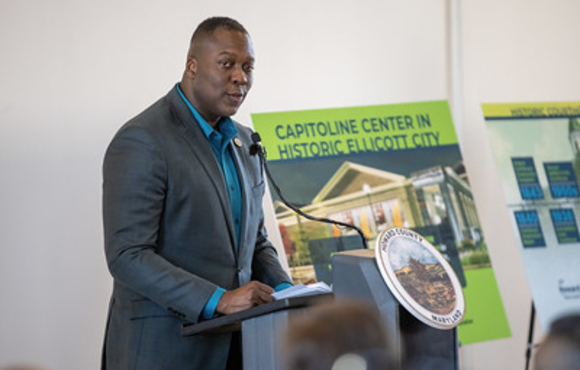
Howard County Executive Calvin Ball today joined the Howard County Arts Council, the Department of Recreation & Parks, and community members to celebrate the long-awaited grand opening of The Capitoline Center in historic Ellicott City. Photos from the event can be found on Howard County Government’s Flickr website.
After nearly two years of construction, our vision of transforming this iconic landmark into a community-centered space has come to completion with the grand opening of Howard County’s new The Capitoline Center. This generational project represents an approximately $20 million investment from the County, the State, and our federal partners and a shared commitment to preserving history while investing boldly in the future. Once a seat of justice, The Capitoline Center is now home to multiple anchors that will bring daily life and energy into this revitalized landmark. Thank you to all who have contributed and supported this project.
The Capitoline Center is located at 8360 Court Avenue at the site of the former State of Maryland's Circuit Court for Howard County courthouse in historic Ellicott City. In 2021, the Circuit Court was relocated to its newly constructed, state-of-the-art facility at 9250 Judicial Way in Ellicott City. Following the closure of the historic courthouse, the County initiated a public survey to gauge the community’s interest in the future of the property. Through this survey, nearly 600 residents, business owners, and community stakeholders shared an overwhelming desire to see the building repurposed into an expanded public space, for community, cultural, civic, and food-related uses, as well as events.
In 2023 during his State of the County speech, Ball announced the adaptive reuse of the historic courthouse into a 80,000-square-foot transformative new center for arts, culture, and history. Supported by funding from the County, the State of Maryland, and federal grants, the total project cost for Phase 1 was approximately $20 million, of which roughly $9 million was funded through grants and roughly $11 million was funded by the County.
The name, The Capitoline Center, was chosen because the building sits at the top of Capitoline Hill in historic Ellicott City. It is suspected that early settlers of Ellicott City were inspired by the town’s rocky and hilly Roman geography and named Ellicott City’s ‘Capitoline Hill’ after Capitoline Hill near the River Tiber that winds through central Italy and is one of the Seven Hills of Rome. Not coincidentally, The Capitoline Center overlooks Parking Lot D, where Howard County’s own Tiber River meets the Hudson branch in Ellicott City.
“In a time when our values are being challenged, this new Capitoline Center--with timeless Greek facade and granite cupola--is a clear and resounding testament that in the face of adversity, we are proud of our cultural, heritage, history, and diversity. That through arts and performances, and we welcome people of all colors and stripes across our community to come together at this location once again,” said Clarence Lam, Maryland State Senator.
“The Capitoline Center will serve as a hub for arts, culture, and history in Howard County. It is a place where residents can gather, learn, create, and celebrate together,” said Christiana Rigby, Vice Chair of the Howard County Council. “Arts connect us; it transcends differences, bridges generations, and allows us to see one another more clearly. Culture grounds us; sharing our culture, and learning from the cultures of others, gives us roots, foundation, and a deeper sense of belonging.”
Inside The Capitoline Center, visitors will find the new headquarters of the Howard County Arts Council and the county's first Asian American and Pacific Islander (AAPI) Cultural Center, as well as the future home of the County's Roving Radish program and a Shared Commercial Kitchen space. Combining all these functions into one location in historic Ellicott City will help facilitate increased tourism while supporting the local economy.
Howard County Arts Council
Formerly located in the County’s High Ridge Center, the Howard County Arts Council’s (HCAC) new space at The Capitoline Center includes: 18 resident artist studios; three designated spaces for resident arts organizations; one black box theatre with flexible seating; two dressing rooms; one dance studio; two art galleries; three arts classrooms; one multi-purpose space for community art groups and others to hold large meetings and workshops; classroom, office, gallery and theatre storage space; and office space for the Arts Council.
“What a wonderful day for arts and culture in Howard County and historic Ellicott City! This project is a great story of how the arts and cultural communities can work with the County and other partners to achieve great things. Our fabulous new galleries, community black box theatre, classrooms, and visual arts and dance studios at the Capitoline Center will provide much-needed work space for artists and creative spaces for County residents and visitors to enjoy the arts,” said Coleen West, Executive Director, Howard County Arts Council. “For years - the Arts Council has been looking for home in a more central, vibrant location to serve as a community gathering place and destination for the arts. Today we are celebrating the realization of that dream.”
Established in 1981 to fulfill the County’s mandate of an arts and cultural commission for the county, the HCAC has been fostering the arts and ensuring community access to the arts in partnership with County ever since. HCAC’s new location will allow the Council to grow and expand its programming, as well as create a more central, walkable location with access to parking and public transportation, addressing the Council’s needs and aligning with its past and current strategic plans.
Importantly, this move to historic Ellicott City creates an opportunity for HCAC to seek a designation for the town as a statewide Arts and Entertainment District.
"Access to the arts is crucial for Marylanders' exceptional quality of life and essential to keeping Maryland a strong, arts-vibrant state,” said Steven Skerritt-Davis, Executive Director, Maryland State Arts Council. “As one of the first projects awarded an Arts Capital grant, the Maryland State Arts Council is thrilled to celebrate the Capitoline Center's grand opening, which will allow the Howard County Arts Council to build on its long, impactful history and continue connecting individuals and the community to the arts.”
AAPI Cultural Center
In the last decade, Howard County’s AAPI population has grown considerably, with residents identifying as Asian American now making up approximately 20 percent of the county. To represent this population and the growing integral part they play in Howard County’s culture and society, Ball established the AAPI Workgroup in February 2021. Five months later, his administration secured funding from the Maryland General Assembly to construct an AAPI Cultural Center. It took two additional years to secure the necessary funding to renovate the historic Circuit Courthouse.
The new AAPI Cultural Center will serve as a one-stop referral center for AAPI residents – many of whom are new immigrants – who are seeking access to social programs and other resources, as well as a hub where Asian Americans can form coalitions and obtain help with the U.S. citizenship application process and registering to vote. The center includes a lounge and social space, exhibit space, offices, and a flexible dance/martial arts studio.
“The opening of the Capitoline Center is a proud milestone for Howard County, transforming our historic courthouse into a vibrant home for arts, culture, and community,” said Kui Zhao, Chair, Asian American & Pacific Islander Commission. “This Center reflects the strength and unity of our diverse residents, and we look forward to it inspiring creativity and connection for generations to come.”
Roving Radish and Shared Commercial Kitchen Space
With work set to commence this summer and be completed by the fall of 2027, the next phase of historic courthouse’s renovation will include the transformation of approximately 10,000-square-feet of space into a new home for the County’s award-winning Roving Radish program, a shared teaching/commercial kitchen, and additional multipurpose community space.
Once complete, the Roving Radish’s approximately 4,000-square-foot space will serve as the program’s new headquarters and will offer staff a space to prepare, package, and sell its meal kits. Since the program’s inception in 2015, the Roving Radish has distributed more than 65,000 meal kits, with 40 percent of them subsidized.
This space will also include a Demonstration/Teaching Kitchen, which can be used to teach cooking classes and support the culinary arts.
Historic Circuit Courthouse History
A Maryland historical landmark, the historic Circuit Courthouse along Capitoline Hill in Old Ellicott City was built between 1840 and 1843. Made of local granite, the courthouse exemplifies the style of Greek Revival architecture with a prominent cupola that stands tall over Historic Ellicott City as an iconic landmark.
The building originally conceived, most likely was a simple rectangular box, as the stylistic details now present – the corner pilasters, cornice and door surround with cornice – were all part of a “change order” in February 1841. In 1938, the courthouse received $40,000 from the Federal government to construct a two-story addition to the rear of the building. This and future additions allowed the State to keep the old courthouse in use until its replacement was built and opened in 2021, as well as led to a substantial granite structure that now serves as the entrance to the courthouse.
“This is what community looks like — honoring where we’ve been while boldly stepping into who we’re becoming,” said Tami Shaw, Executive Director, Ellicott City Partnership. “The Capitoline Center is a powerful investment in inclusion, arts, and the future of Howard County.”
The transformation of the historic courthouse into The Capitoline Center supports the policies established for the reuse of the property in the Ellicott City Watershed Master Plan, as well as provides a resource that is complementary to the existing businesses located in historic Ellicott City.