
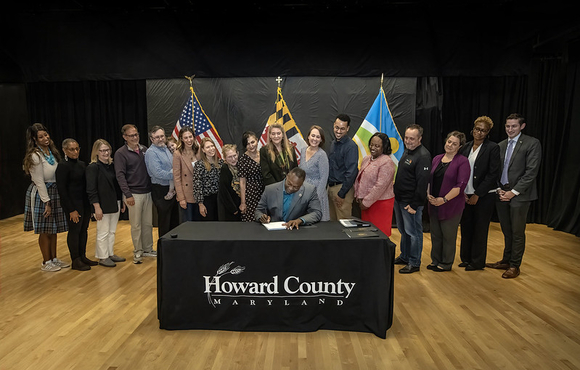
ELLICOTT CITY, MD – Howard County Executive Calvin Ball today signed four pieces of local legislation that will support the Howard County Arts & Culture Plan, approve BikeHoward 2026, expand the property tax credit for day care providers, and establish a property tax credit for retired Public Safety Officers. The Howard County Council passed all four pieces of legislation earlier this month. Photos of the event can be viewed on Howard County Government’s Flickr webpage.
Howard County is now recognized as one of the best places in our nation to live, work, play, grow, and thrive for all. We’ve earned that reputation by making thoughtful decisions and advancing meaningful policies that support our residents, businesses, and workforce. Through these pieces of legislation, we are ensuring our community remains a vibrant place where creativity can flourish, where everyone can travel safely, and where we deliver real support for the people and public servants who care for us.
Council Resolution (CR) 159-2026 supports the Howard County Arts & Culture Plan. In the County’s General Plan, HoCo By Design, arts and culture were established as part of the county's economic prosperity framework. In response, the Howard County Arts Council secured funding from the County, the Maryland State Arts Council, and the National Endowment for the Arts in 2025, to undertake a 20-month community planning process to compliment HoCo By Design with a blueprint for artistic development and growth. Led by a 31-member steering committee comprised of local artists, creative practitioners, civic and educational leaders, and County officials, the process involved rigorous research, community engagement, a review of cultural assets, and listening to artists, business owners, and community stakeholders.
Viewed as an expansion of HoCo By Design's economic prosperity framework, the Howard County Arts & Culture Plan establishes arts and culture as a cross-cutting priority touching economic development, community belonging, equity, education, and the built environment. The Plan also provides a framework for how arts and cultural communities can work with the governing body and other partners to address community priorities, support artists, creators, and creativity, advance arts and culture for all, and strengthen Howard County's position as a hub for innovation and creativity in the region. Moreover, the Plan's goals and strategies will help guide arts and culture decision-making and provide actionable steps to increase awareness of cultural opportunities, diversify cultural offerings, and strengthen the county's identity as a vibrant cultural destination.
CR160-2026 approves BikeHoward 2026 – an update to the County’s Bicycle Master Plan, as well as supports the County’s application to be designated a bicycle friendly community by the League of American Bicyclists. BikeHoward 2026 builds on the original plan that was adopted by the Howard County Council in 2016 and reflects the County’s Complete Streets Policy, Complete Streets Design Manual, and HoCo By Design. Additionally, it incorporates new evaluation tools, such as Bicycle Level of Traffic Stress analysis.
Developed with extensive public input and oversight from the County’s Office of Transportation and Department of Public Works, Bicycle Advisory Group, and the County’s consultant RK&K, BikeHoward 2026 incorporates national best practices and applies them effectively to Howard County’s local context. The plan will provide guidance and enhanced coordination amongst county and state agencies, developers, grant administrators, and the public when it comes to infrastructure improvements, policies, and programs. BikeHoward 2026 aims to further develop the county’s path forward of become a leading bicycle-friendly community where people of all ages and abilities can safely bike for transportation and recreation.
Since taking office, Ball has invested $77 million in bicycle, pedestrian, and Complete Streets improvements in Howard County, reflecting a historic increase in funding for multimodal transportation improvements.
Council Bill (CB) 52-2026 repeals the current credit for day care provider, family day-care homes, and group care centers and replaces it with separate credits for certain day care providers and day care credits for large child care centers consistent with State law authority.
Under the current code, there is a State authorized property tax credit of up to $3,000 for day care providers only against any improvements made at the day care center. The improvements must be modifications or additions of real property at the center. Due to the narrow scope of the tax credit, there have only been six credits issued in the last five fiscal years. In 2025, new State law authorized a $10,000 tax credit for large child care centers.
CB52-2026 repeals the existing credit and replaces it with an expanded real property tax credit of up to $5,000 for day care centers and up to $10,000 for large day care centers (25-plus employees). The tax credit will become available in the tax year that begins July 1, 2027, and will impact the County’s Fiscal Year 2028 budget.
CB52-2026 aims to keep care services affordable and available for families, strengthen and promote local businesses, and support a more reliable workforce. Currently, Howard County has more than 400 child and adult care providers. This current supply of providers is inadequate to meet the need of the community, particularly for families with children aged newborn to three years old, and there continues to be waitlist for before and after care for school aged children. Assuming all current providers meet the eligibility requirements and qualify for maximum day care tax credit, the annual tax credit would be approximately $3.2 million.
CB53-2026 establishes a property tax credit for retired Public Safety Officers who have retired from a public safety agency in Howard County. This credit will provide meaningful support to those who have served the community, helping reduce their housing costs and reinforcing the county’s commitment to its public safety workforce.
The Public Safety Officer Property Tax Credit is a State authorized tax credit against the real property tax up to $2,500. The credit is available for full-time officers in various public safety departments, including firefighters, emergency medical technicians, police officers, dispatchers, correctional officers, deputy Sheriffs, and volunteer fire fighters, and it does not expire.
CB53-2026 expands the eligibility of this tax credit to include officers who have retired from service in eligible positions. Additionally, the legislation ensures that retired public safety dispatchers are included in the offered tax credit qualifying as public safety officers.
Per the Conty’s Department of Finance, there are currently 128 retired public safety officers who would become eligible for the tax credit.